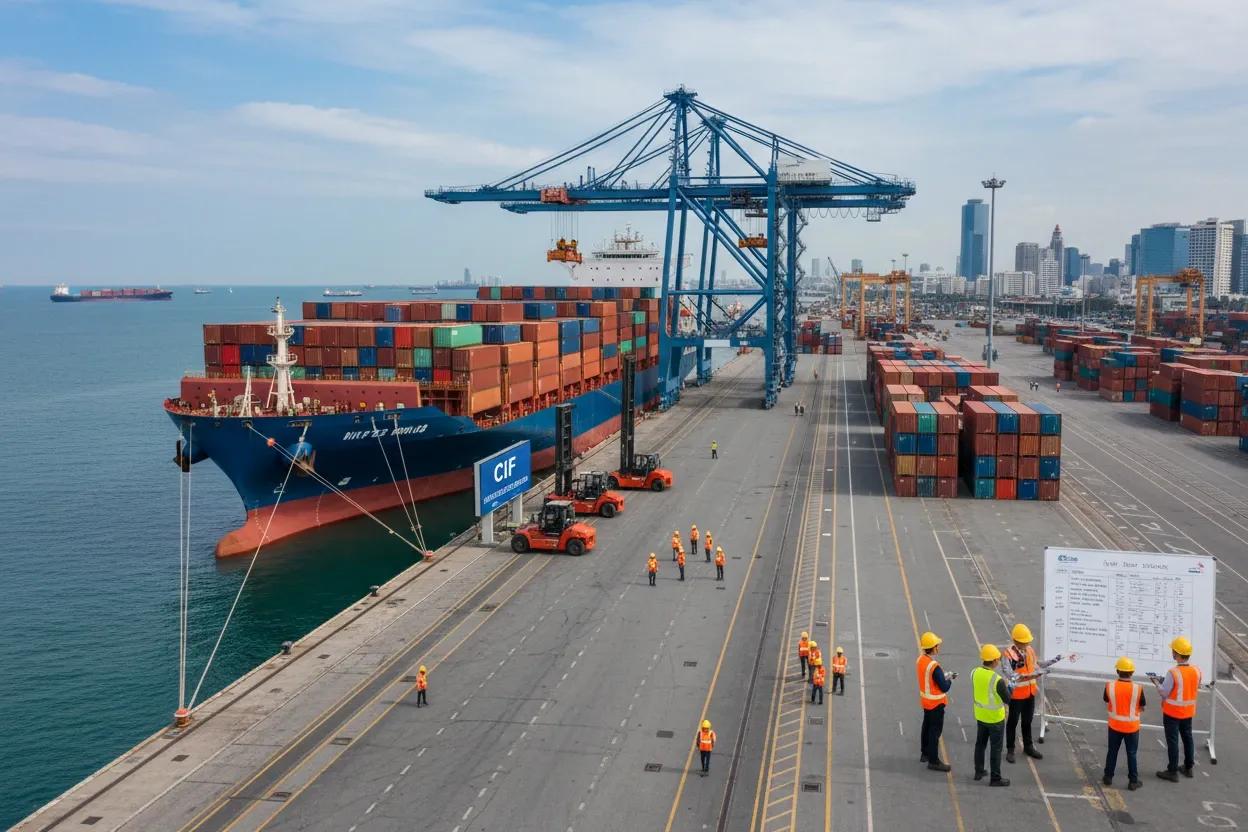
The term CIF is commonly used in international trade and cross-border shipping transactions. Under the agreement, the seller is responsible for arranging and paying for the transportation and insurance of goods.
While CIF helps simplify international shipping arrangements, businesses still face the challenge of maintaining visibility and control over their goods once they enter the distribution network. From inbound to delivery execution, companies need real-time visibility to ensure operational efficiency, inventory accuracy, and the safeguarding of valuable assets.
What Is CIF?
Cost, Insurance and Freight (CIF) is one of the international trade terms defined by the International Chamber of Commerce.
Under a CIF agreement, the seller is responsible for covering the cost of goods, insurance, and freight charges required to transport the goods to the destination port. Once the goods arrive at the destination port, the buyer usually takes over. The buyer handles import clearance, warehousing, inventory management, distribution, and sales operations.
CIF is often used in international trade because it makes shipping easier for buyers. It also ensures the goods are insured during transit.
Concept of CIF
CIF is an Incoterms rule that defines the responsibilities between seller and buyer in international shipping. It sets clear terms on how costs, insurance, and freight are managed during the transportation of goods.
- Cost
The seller covers all costs related to the goods until they arrive at the destination port. These costs include product packaging, export documentation, and international shipping preparation. Every expense needed to move the goods from origin to destination port falls under the seller’s responsibility. - Insurance
The seller is also required to provide insurance coverage for the shipment during transit. This insurance typically offers basic protection against common risks during transportation. - Freight
Freight charges are also paid by the seller. This includes the cost of transporting goods by sea from the port of origin to the agreed destination port as stated in the contract.
Although the seller pays for cost, insurance, and freight, the risk of loss or damage transfers to the buyer once the goods are loaded onto the vessel at the port of shipment. From that point onward, the buyer carries the risk.
Advantages of CIF
CIF (Cost, Insurance, and Freight) provides several advantages in international trade, particularly in managing shipping responsibilities between buyers and sellers.
- Efficient Shipping Process
Under CIF terms, the seller handles shipping costs and insurance up to the destination port. This arrangement allows the buyer to focus on receiving the goods without needing to coordinate transportation or insurance during transit. - Cost Predictability
CIF provides clarity in total landed cost. Since shipping and insurance are included in the agreed price, the buyer has a clear understanding of total expenses from the beginning of the transaction. This reduces uncertainty related to additional charges during the shipping process and supports better financial planning.
Disadvantages of CIF
CIF offers convenience in international shipping, but it also comes with several limitations that businesses need to consider.
- Risk Transfers Early to the Buyer
Although the seller pays for shipping and insurance, the risk of damage or loss shifts to the buyer once the goods are loaded onto the vessel at the port of origin. Any issue that occurs during the main transportation phase becomes the responsibility of the buyer, even if the shipment is still in transit. - Limited Control Over Insurance
Under CIF terms, the seller selects and manages the insurance coverage for the shipment. The buyer does not have direct control over the choice of insurance provider or the level of protection included in the policy. This can result in coverage that may not fully align with the buyer’s preferred risk management standards.
Challenges of Managing Goods
While CIF simplifies international procurement by placing freight and insurance responsibilities on the seller, businesses still face a critical challenge once goods enter their own distribution network: maintaining real-time visibility of goods across the supply chain.
As distribution networks grow more complex, products often move across multiple warehouses, sales channels, and delivery routes. Without accurate and timely information, it becomes increasingly difficult for businesses to maintain control over operations.
- Lack of Real-Time Visibility
One of the biggest challenges faced by distributors is maintaining real-time visibility of goods as they move through the distribution network.
From the moment products are received at the warehouse until they are delivered to customers, businesses need accurate and timely information about the location, status, and movement of their inventory. - Delayes Reports
Limited visibility across operations can lead to delayed and inaccurate decision-making. When reports are not available in a timely manner, distributors often struggle to evaluate business performance, identify operational issues, and respond to changing market conditions.
To address this challenge, many distributors implement a Distribution Management System (DMS) that centralizes operational data into a single dashboard. A DMS provides access to real-time reports covering sales performance, inventory availability, order fulfillment, distribution activities, and field operations. With better visibility across the business, management teams can monitor key metrics, identify potential issues earlier, and make faster, data-driven decisions. - Inefficient Inventory Management
Poor inventory management is one of the most critical distribution challenges. This challenge can lead to overstock in the warehouse or stock shortages in the market. When products are not replenished on time, especially for fast-moving items, customers may switch to other brands.
By using stock replenishment software, distributors can automatically restock when inventory levels are low. Additionally, warehouse management systems also help optimize operations, from stock opname to picking, packing, and inventory movement. - Delivery Fleet Management Issues
Managing delivery fleets efficiently remains a key challenge for many distributors. It involves evaluating fleets, planning schedules, and ensuring accurate arrival times for each shipment.
Without a proper system, these processes can become inconsistent and lead to delivery delays. By implementing a delivery management system, businesses can plan routes more effectively, manage fleet schedules with greater accuracy, and ensure deliveries arrive on time. - Unoptimized Routes
Road conditions in Indonesia can be highly unpredictable, with frequent traffic congestion and varying travel times. As a result, delivery teams often spend significant time finding the fastest route to reach each outlet.
To solve this distribution challenge, distributors usually use a route optimization software to streamline deliveries. The software analyzes distance, traffic conditions, delivery priorities, and fleet capacity to generate optimized routes that reduce unnecessary travel time.
150+ Renowned Brands Trust BOSNET for Their Distribution
Over 150 brands rely on BOSNET to manage their distribution and sales processes efficiently. BOSNET provides an end-to-end solution for distributors to track operations, performance, and sales in real time.
Contact us to see how BOSNET can streamline your operations and deliver real-time visibility across your distribution network.
#BOSNET #BestFMCGRunsBOSNET #Distribution #SupplyChain #IncreaseRevenue #ReduceCost