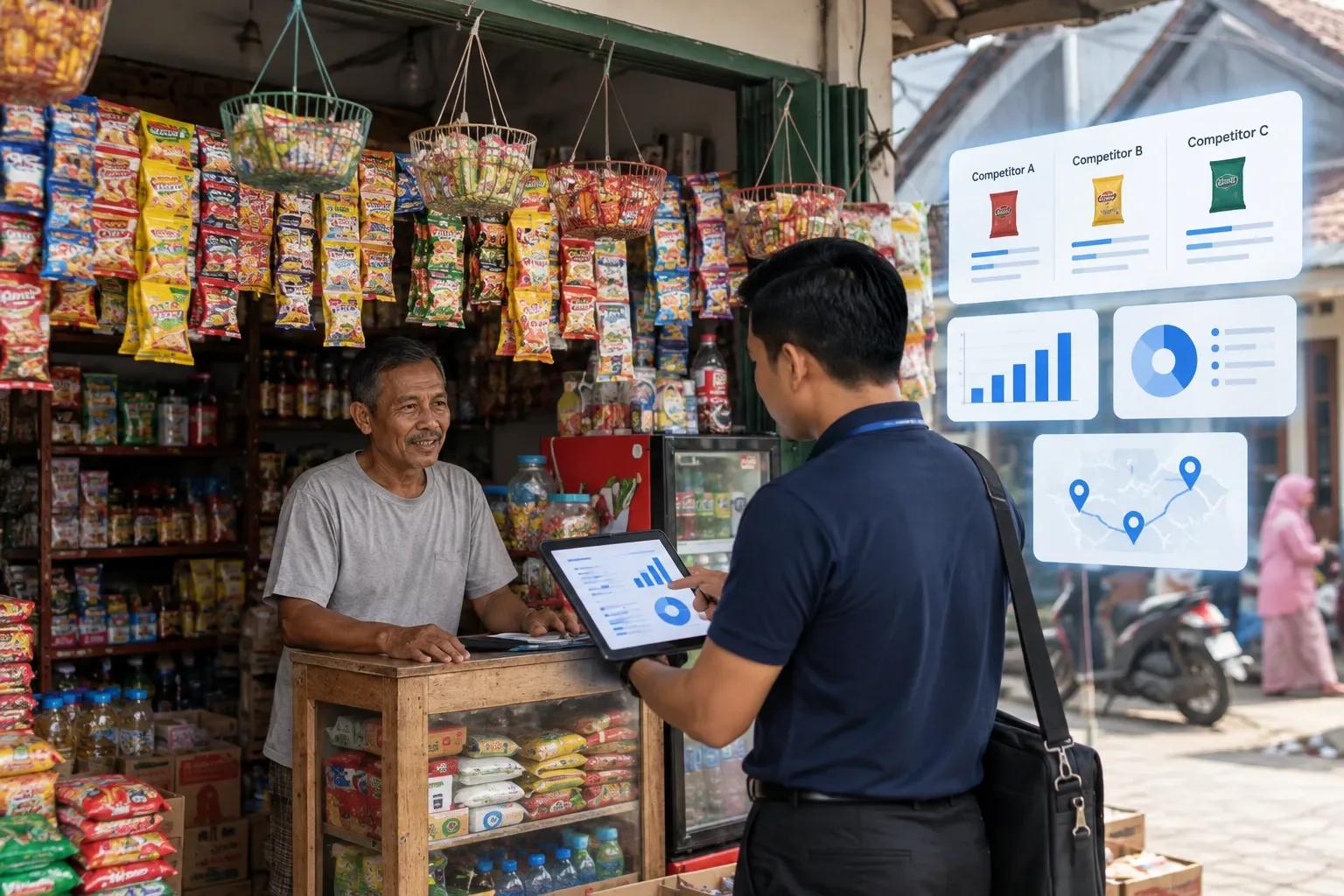
Understanding your business competitors is an important part of planning and managing a business. Competitor analysis helps businesses see how other companies attract customers, position their products, manage pricing, and reach the market.
For distributors and FMCG businesses, competitor evaluation also includes distribution coverage, product availability, sales activities, and operational capabilities. The findings can help businesses identify market gaps and make better decisions based on actual market conditions.
What Are Business Competitors?
Business competitors are companies that offer products or services that target the same customers or address similar needs. Competitors fall into two main categories: direct and indirect.
Direct competitors offer similar products or services to the same target market. For example, two beverage brands selling similar products through the same retail channels may compete directly.
Indirect competitors offer different products but address a similar customer need. A bottled water brand and a soft drink brand may compete indirectly because both can be purchased as beverages for daily consumption.
Identifying both types of business competitors gives companies a broader view of the market and helps them understand where competitive pressure comes from.
7 Steps to Evaluate Your Business Competitors and Their Strategy
- Identify Your Main Business Competitors
Start by listing the companies that compete for the same customers. Focus on competitors that operate in the same market, product category, geographic area, or distribution channel.
Separate competitors into direct and indirect groups. The list can include:
- Companies offering similar products
- Brands targeting similar customer segments
- Businesses operating in the same geographic areas
- Companies using similar sales and distribution channels
- New businesses entering the market
For example, an FMCG distributor may evaluate other distributors serving the same outlets, regions, or product categories.
Review the competitor list regularly. New market entrants, product launches, and changes in distribution channels can alter the competitive landscape. - Analyze Their Products and Services
Next, examine what competitors offer customers. Product analysis helps businesses understand how competitors position their offerings and where their products differ.
Consider factors such as:
- Product range
- Product variants and sizes
- Price points
- Product availability
- Service coverage
- Product quality
- Unique product features
For FMCG businesses, product availability can be as important as the product itself. A competitor with wider outlet coverage may reach customers more frequently, even when competing products have similar features.
Comparing product portfolios can also reveal market gaps. A competitor may focus heavily on premium products while leaving opportunities in the mid-range segment. - Study Their Target Market
Understanding who competitors serve helps explain their sales and marketing decisions.
Review their target customers based on factors such as:
- Customer demographics
- Geographic areas
- Outlet types
- Purchase behavior
- Price sensitivity
- Business size
Distribution businesses can also examine whether competitors focus on traditional trade, modern trade, horeca, e-commerce, or other channels.
For example, one distributor may focus on large retail chains, while another may have wider coverage among smaller outlets. Each strategy creates a different market position.
Studying target markets helps businesses identify customer groups that may be underserved or have limited access to products. - Evaluate Their Pricing Strategy
Price comparison provides insight into how competitors position their products in the market. Look at:
- Standard selling prices
- Promotional prices
- Discounts
- Bundling offers
- Volume-based pricing
- Trade incentives
- Price differences between channels
Price analysis should consider the full commercial context. A lower selling price may be linked to a specific promotion, larger order quantity, or different channel strategy.
For example, a competitor may offer a temporary discount to increase product movement in selected outlets. Another company may maintain a higher price while focusing on premium positioning. - Examine Their Marketing and Sales Strategy
Marketing and sales activities show how competitors attract customers and generate demand.
Review their activities across different channels, including:
- Retail promotions
- Trade promotions
- Sales representatives
- Events and campaigns
- E-commerce channels
- Customer loyalty programs
Sales activities are also worth examining. Businesses can compare sales force coverage, visit frequency, order-taking methods, and customer engagement.
For example, a competitor with frequent sales visits may maintain higher product visibility across outlets. Another competitor may rely heavily on digital ordering and promotional campaigns. - Assess Their Operational and Distribution Strategy
Competitor analysis should not stop at products and marketing. Operational capabilities can directly affect market coverage and product availability.
Review areas such as:
- Warehouse capacity
- Inventory management
- Delivery coverage
- Delivery frequency
- Route planning
- Fleet capacity
- Order processing
- Sales and delivery coordination
For FMCG distributors, distribution performance can influence how quickly products reach outlets and how often customers can replenish their stock.
For example, a competitor with wider delivery coverage may reach more outlets across a region. A competitor with higher delivery frequency may also maintain product availability at outlets more effectively.
Operational analysis helps businesses understand how competitors turn their commercial strategy into actual market execution. - Compare Their Strengths, Weaknesses, and Market Position
The final step is to compare your business with your competitors. Focus on key areas such as:
- Products: What products and variants do they offer?
- Pricing: How do their prices and promotions compare?
- Market coverage: Which areas and customers do they serve?
- Distribution: How widely are their products distributed?
- Sales: How do they reach and serve customers?
- Promotions: What campaigns and offers do they use?
- Delivery: How do they manage product delivery?
- Customer segments: Which customers do they target?
Use the findings to identify where your business performs well and where there are gaps. The goal is to understand your position in the market and find areas that may need attention.
How to Organize Your Competitor Analysis
A competitor analysis becomes more useful when you collect information in a consistent format.
Create a comparison framework covering the areas that directly affect your business. Depending on the industry, the framework may include:
- Product
- Price
- Target market
- Distribution coverage
- Sales activities
- Promotions
- Customer experience
- Delivery
Assign data or observations to each category. Compare quantitative data such as prices, outlet coverage, and delivery frequency with qualitative observations such as positioning and promotional messaging.
Why Competitor Analysis Matters for FMCG Business
Competitor analysis gives businesses a better view of the market they operate in. It can help identify opportunities that may not be visible when a company only reviews its own performance.
Key benefits include:
- Identifying underserved market segments
- Finding gaps in product availability
- Comparing pricing positions
- Understanding competitor distribution coverage
- Reviewing sales and promotional tactics
- Anticipating changes in market activity
- Finding areas for operational improvement
For distributors, competitor analysis can also be linked to outlet and distribution data. Comparing product availability, sales coverage, and geographic reach can show where competitors are gaining market access.
Evaluate Your Business Competitors with BOSNET Mobile Distribution
BOSNET Mobile Distribution helps sales teams record field activities, monitor customer visits, and collect market information directly from the field. Real-time data gives businesses better visibility into sales execution and customer coverage.
Contact us to learn how BOSNET Mobile Distribution can help your business monitor field activities and manage your distribution operations.
#BOSNET #BestFMCGRunsBOSNET #Distribution #SupplyChain #IncreaseRevenue #ReduceCost