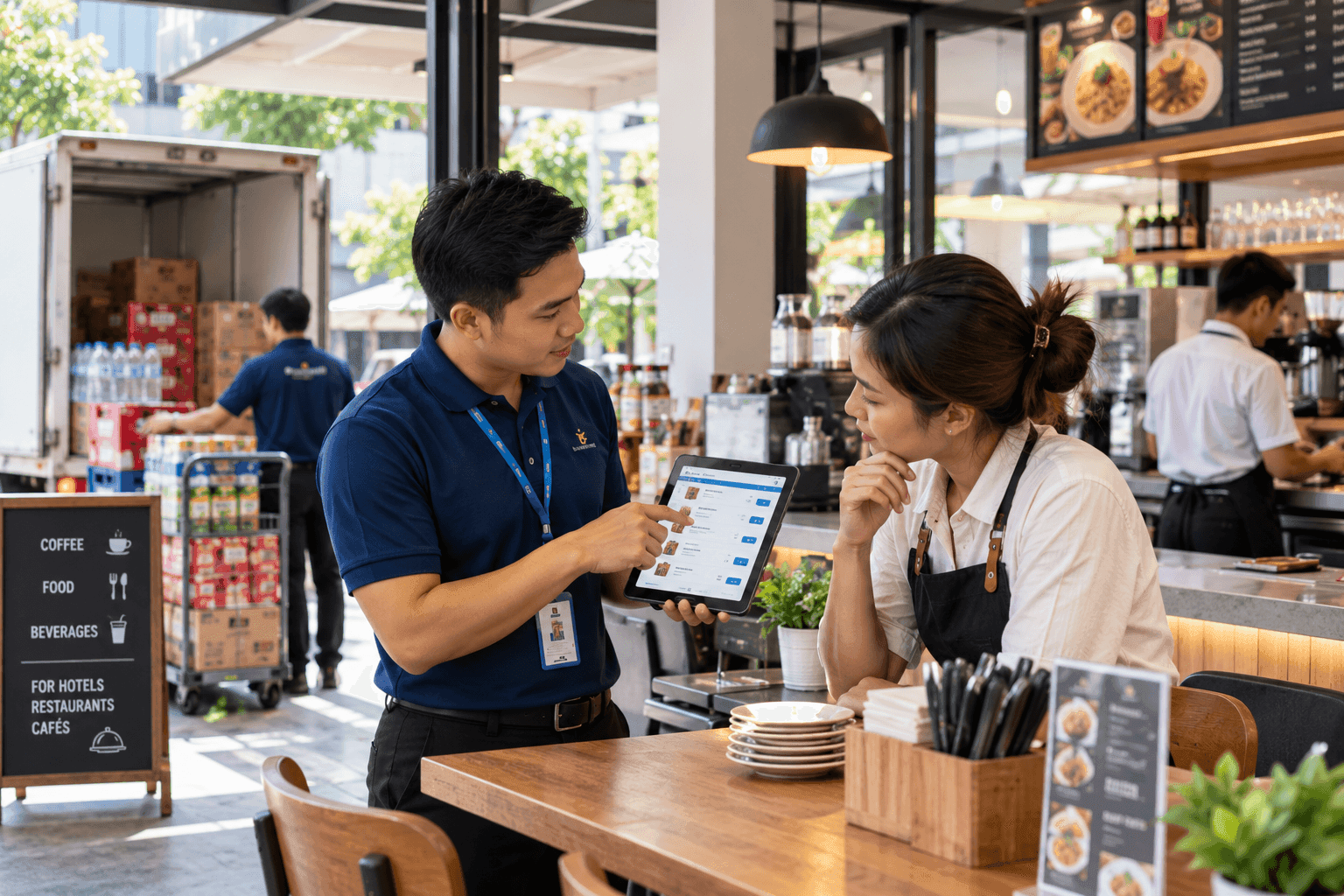
Hotels, restaurants, and cafés depend on a steady supply of food, beverages, and other operational necessities to serve their customers. Managing these supplies requires coordination between businesses, suppliers, and distributors, particularly when demand changes or product availability becomes limited.
HORECA is a term used to describe the hotel, restaurant, and café or catering sectors. The industry plays an important role in the food service market, connecting product suppliers with businesses that prepare and serve food and beverages. Understanding how the HORECA industry works helps businesses identify operational challenges and manage their supply requirements.
What Does HORECA Stand For?
HORECA stands for Hotels, Restaurants, and Cafés/Catering. The term groups businesses that serve food and beverages, although their operating models and purchasing requirements may differ.
- Hotels
Hotels require a range of products to maintain guest services, including food ingredients, beverages, cleaning supplies, and guest amenities. Properties with restaurants or catering facilities may also need regular deliveries to support kitchen operations and food service.
Purchasing requirements often depend on occupancy rates, guest preferences, and the services offered by the property. - Restaurants
Restaurants purchase ingredients, beverages, and other supplies to prepare meals and serve customers. Their stock requirements depend on menu selections, customer traffic, and the shelf life of the ingredients they use.
For example, a restaurant serving fresh seafood must coordinate purchasing and deliveries carefully to maintain product quality and avoid unnecessary waste. - Cafés and Catering Businesses
Cafés typically require coffee, milk, syrups, baked goods, and other ingredients based on their menus. Catering businesses may handle larger orders for specific events, making their purchasing needs dependent on event schedules and the number of guests.
Both business types need to manage stock according to expected demand while maintaining product quality and availability.
How Does the HORECA Industry Work?
The HORECA supply chain connects manufacturers, distributors, and food service businesses. Each participant has a role in ensuring products reach the point of use at the required time and quantity.
Manufacturers produce food, beverages, and other supplies. Distributors purchase products from manufacturers or suppliers and deliver them to hotels, restaurants, cafés, and catering businesses.
HORECA businesses then use these products to prepare meals, serve beverages, or provide guest services.
For example, a beverage distributor may supply bottled drinks to several restaurants. The distributor must receive orders, check available stock, prepare deliveries, and coordinate delivery schedules. Restaurants depend on the distributor to replenish their supplies before stock runs out.
The relationship involves more than product delivery. Order accuracy, product quality, delivery timing, and communication between trading partners all affect daily operations.
Key Challenges in the HORECA Industry
HORECA businesses face operational challenges related to changing demand, inventory control, and supply coordination. Their requirements can also vary based on the type of establishment and the products they purchase.
- Fluctuating Customer Demand
Customer traffic can change according to the day of the week, holiday periods, local events, and seasonal travel. Hotels may experience higher occupancy during holiday seasons, while restaurants may receive more orders during weekends.
Unpredictable demand makes purchasing decisions harder to plan. Excess purchases can lead to waste, particularly for perishable goods, while insufficient stock may limit menu availability.
Businesses need to review sales patterns, upcoming bookings, and purchasing records to estimate their requirements. - Managing Perishable Inventory
Food service businesses often handle products with limited shelf lives, including fresh produce, dairy products, meat, and seafood. Poor stock rotation or excessive purchasing can result in spoilage and financial losses.
Businesses need to monitor expiry dates, storage conditions, and stock quantities. Applying the first-expired, first-out (FEFO) method helps ensure products with earlier expiry dates are used or sold before those with later dates.
Suppliers and distributors also need to consider product shelf life when storing, handling, and delivering perishable goods. - Maintaining Product Availability
HORECA businesses depend on product availability to maintain their menus and service schedules. A shortage of a key ingredient or beverage may require a restaurant to change its menu or temporarily stop offering certain items.
Stock shortages can result from inaccurate demand estimates, delayed deliveries, or insufficient inventory at the supplier's warehouse.
Regular stock monitoring and coordination with suppliers help businesses identify replenishment needs and reduce the risk of product shortages. - Controlling Purchasing and Operating Costs
Food prices, transportation expenses, and supplier pricing can affect HORECA operating costs. Businesses must manage purchasing quantities carefully to avoid holding excess stock while maintaining sufficient supplies for daily operations.
For example, ordering large quantities may reduce the purchase price per unit, but the savings may be offset by storage expenses or spoilage if demand is lower than expected.
Reviewing purchasing patterns, inventory levels, and supplier terms helps businesses assess the cost implications of their buying decisions. - Coordinating Suppliers and Deliveries
Hotels, restaurants, and cafés often purchase products from multiple suppliers. Each supplier may have different order requirements, delivery schedules, and product availability.
Poor coordination can lead to late deliveries, incomplete orders, and additional work for receiving teams. Businesses need to communicate their requirements clearly and monitor incoming deliveries to ensure products arrive according to schedule.
Distributors also need to coordinate order processing, warehouse availability, and delivery planning to meet customer requirements.
Improve Your HORECA Distribution With BOSNET Solutions
BOSNET connects key distribution processes across every touchpoint, covering sales, inventory, warehouse, delivery, and field operations through an integrated digital ecosystem.
Each solution supports a specific touchpoint within the distribution process, while connected data gives businesses visibility across daily operations.
- Mobile Distribution
Mobile Distribution is a mobile application designed to help field sales teams manage customer visits and sales activities.
The application provides visibility into field operations, standardizes sales reporting, and enables sales representatives to record activities directly on their mobile devices. - Distribution Management System (DMS)
A Distribution Management System (DMS) serves as the foundation of distribution automation by managing and automating key operational processes.
The system centralizes sales activities, order management, inventory information, and distribution operations in a single platform. With real-time visibility across the business, companies can reduce manual work, minimize input errors, and improve operational accuracy. - Warehouse Management System (WMS)
A Warehouse Management System helps businesses manage warehouse activities more efficiently.
The system automates processes including receiving, storage, picking, and shipping activities. As a result, businesses can improve inventory management, reduce labor costs, and maintain accurate inventory records across warehouse operations. - Smart Route
Route optimization solutions help businesses identify the most efficient delivery routes for field teams and drivers. - Mobile Delivery
Mobile Delivery enables drivers and delivery teams to manage distribution activities directly from their mobile devices. The solution provides real-time delivery tracking, digital proof of delivery, and delivery confirmation.
From sales execution and order management to warehouse operations and delivery processes, BOSNET helps businesses gain better visibility across the entire distribution cycle.
It's time to move beyond manual processes and adopt a distribution system designed to support future business growth.
Contact us today to learn how BOSNET can help automate your distribution business.
#BOSNET #BestFMCGRunsBOSNET #Distribution #SupplyChain #IncreaseRevenue #ReduceCost