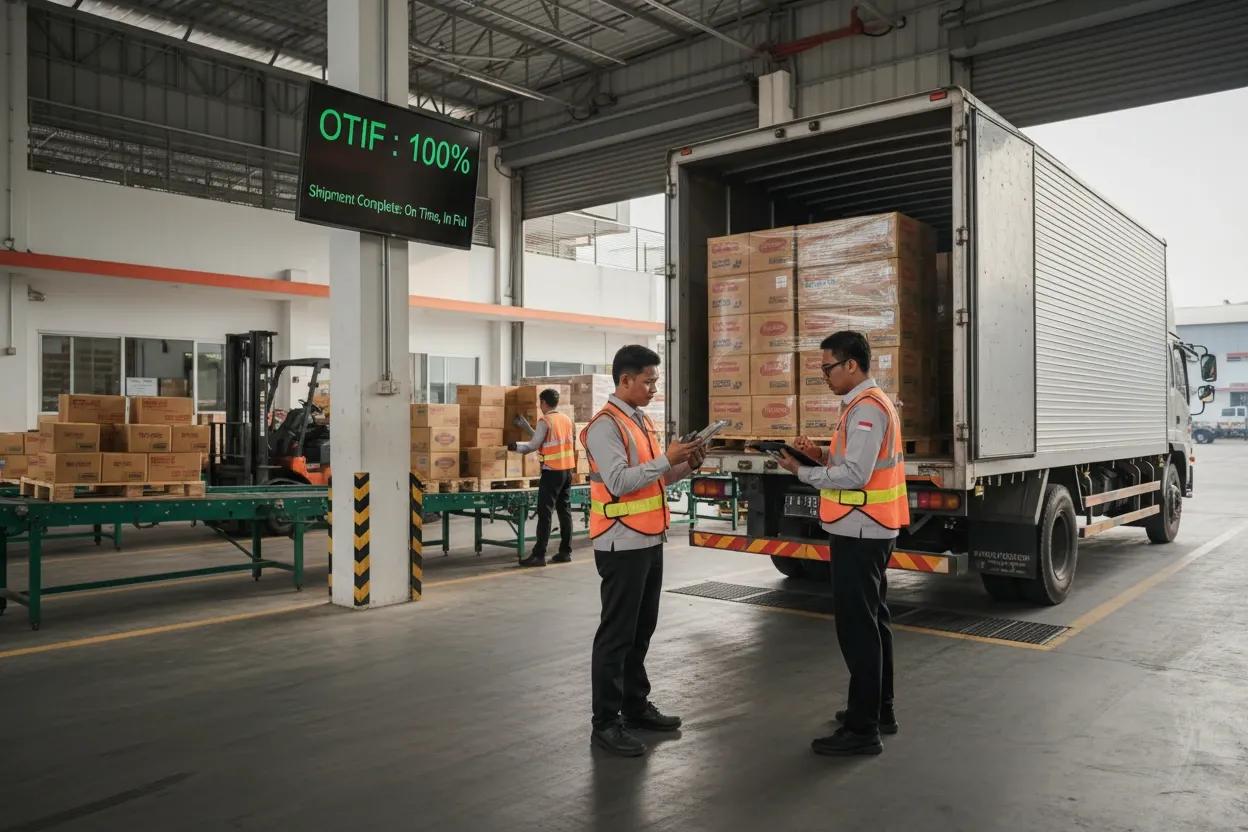
Late deliveries and incomplete orders can quickly impact customer satisfaction and business performance. Customers expect products to arrive according to schedule and in the quantities they ordered. When those expectations are not met, distributors may face complaints, lost sales opportunities, and declining customer trust.
To address these challenges, many companies rely on OTIF (On-Time In-Full) as a key performance metric. It helps businesses measure whether deliveries arrive according to schedule and whether customer orders are fulfilled completely, providing a clearer view of delivery performance across the distribution process.
What Is OTIF (On-Time In-Full)?
OTIF is a key performance indicator used in supply chain management to evaluate delivery performance. Each shipment is measured based on two criteria: whether the order arrives on time and whether the customer receives all ordered items.
A high score indicates that a company consistently meets customer expectations for delivery speed and order completeness. For distributors, manufacturers, and retailers, the metric is widely used to measure service quality and supply chain performance.
- On-Time
The On-Time metric measures whether an order is delivered on the agreed delivery date or within the agreed delivery time window. These delivery commitments are typically defined in the Service Level Agreement (SLA) between the seller and the customer.
Even a delay of a few hours can cause an order to miss the On-Time target if it falls outside the agreed schedule. - In-Full
The In-Full metric measures whether every item in the order is delivered completely. An order is considered In-Full only when the customer receives 100 percent of the requested items in good condition.
If even one item is missing, the entire order does not meet the In-Full criteria, regardless of when the remaining items arrive.
Why Is OTIF Important for Distributors?
OTIF reflects how well a distributor manages inventory, warehouse, and delivery. A consistent OTIF score also helps companies identify operational issues before they impact customer service and business performance.
- Improve Customer Satisfaction
Customers expect deliveries to arrive on schedule and with every item they ordered. When orders are delivered on time and in full, distributors build trust and create a better customer experience. Consistent delivery performance also encourages repeat orders and long-term business relationships. - Reduce Operational Costs
Poor delivery execution often leads to additional expenses, including redelivery costs, expedited shipments, and contractual penalties caused by delays or incomplete orders.
Better coordination across inventory, warehouse, and delivery activities helps distributors reduce unnecessary costs and improve resource utilization. - Support Better Inventory Management
OTIF data helps companies identify inventory issues that prevent orders from being fully fulfilled, such as stock-out. These insights allow distributors to improve demand forecasting and inventory planning, helping to maintain product availability and reduce working capital tied up in slow-moving stock.
How to Count OTIF
To measure delivery performance accurately, companies need to calculate OTIF consistently. The calculation is based on the percentage of orders that meet both delivery criteria: On-Time and In-Full.
OTIF (%) = (Number of Orders Delivered On-Time and In-Full ÷ Total Number of Orders) × 100
Calculation Example
- A distributor delivers 200 orders during a month.
- 170 orders arrive on time and in full.
- 20 orders arrive on time but have missing items.
- 10 orders arrive late.
Only the 170 orders that meet both criteria are counted as OTIF.
OTIF (%) = (170 ÷ 200) × 100 = 85%
In this example, the distributor achieves an OTIF score of 85%, meaning 85 percent of all orders were delivered on time and in full.
Strategies to Improve OTIF
- Optimize Inventory Management
Incomplete deliveries often happen when inventory records do not match actual stock availability or products are unavailable during order fulfillment. To address these challenges, many distributors have adopted a Warehouse Management System (WMS).
Real-time inventory visibility helps warehouse teams monitor stock levels, maintain inventory accuracy, track inventory movement, and simplify putaway activities. A WMS also helps accelerate picking and packing processes, allowing orders to be prepared with greater consistency. - Improve Demand Forecasting
Unexpected spikes in demand can result in stock shortages and delayed deliveries. Demand forecasting helps distributors anticipate sales trends and prepare inventory before demand increases. - Increase End-to-End Supply Chain Visibility
Limited visibility across the supply chain can make issues harder to identify and resolve. A Distribution Management System (DMS) provides end-to-end visibility into inventory, order processing, and product movement across distribution activities. Access to real-time information allows teams to identify disruptions earlier and respond before they impact customer deliveries. - Optimize Delivery Routes
Delivery route optimization helps drivers follow the most efficient routes and reach destinations according to schedule.
Route planning reduces delivery delays, supports on-time performance, and helps distributors achieve higher OTIF scores.
Improve OTIF with BOSNET Solutions
BOSNET provides an integrated suite of solutions that helps improve productivity, increase operational visibility, and manage distribution activities across the business. The following solutions are designed to improve OTIF deliveries:
- Distribution Management System (DMS)
The Distribution Management System helps distributors manage sales orders, order processing, and sales performance across distribution operations. Real-time monitoring allows teams to track operational activities, sales transactions, and inventory from a single dashboard, helping teams respond faster when issues arise. - Warehouse Management System (WMS)
The Warehouse Management System supports inventory management from inbound to outbound processes with high inventory accuracy. Warehouse teams can monitor stock movement, product locations, picking activities, packing activities, and inventory handling throughout warehouse operations. - Mobile Distribution
BOSNET Mobile Distribution gives sales teams quick access to record transactions, manage customer visits, and complete field activities directly from mobile devices. Faster access to field information helps sales teams serve customers according to schedule. - Sales Forecast
BOSNET Sales Forecast estimates future sales volume using historical sales data, market trends, seasonality, and purchasing patterns.
Sales forecasts help businesses prepare inventory earlier, support demand planning, and maintain product availability across distribution channels. - Replenishment
BOSNET Replenishment automates stock refill processes to maintain product availability across distribution channels. Automated replenishment helps reduce the risk of stock shortages and empty shelves. - Smart Route
BOSNET Smart Route optimizes sales visits and delivery routes across operational areas. Route planning helps reduce travel time and allows field teams to reach customers according to schedule. - Mobile Delivery
BOSNET Mobile Delivery allows drivers to manage delivery activities directly from mobile devices. Delivery teams can record delivery status, monitor shipment progress, and provide real-time updates during delivery execution.
150+ Renowned Brands Trust BOSNET for Their Distribution
Over 150 brands rely on BOSNET to manage their distribution and sales processes efficiently. BOSNET provides an end-to-end solution for distributors to track operations, performance, and sales in real time.
Contact us to see how BOSNET can streamline your operations and deliver real-time visibility across your distribution network.
#BOSNET #BestFMCGRunsBOSNET #Distribution #SupplyChain #IncreaseRevenue #ReduceCost