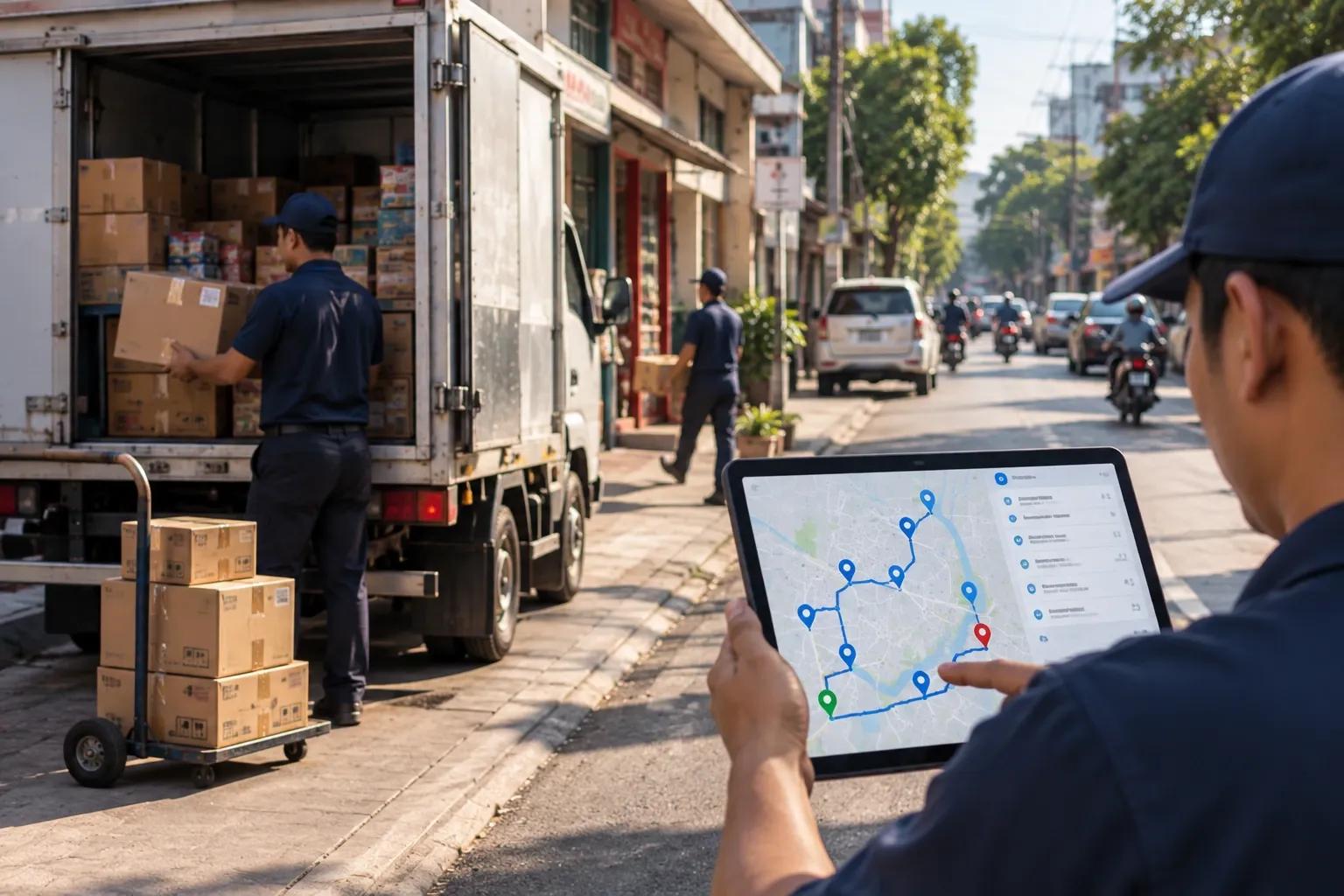
Distribution costs are closely connected to how products move from warehouses to customers and outlets. Long travel distances, poorly planned delivery sequences, low vehicle utilization, and traffic delays can increase fuel consumption and transportation expenses.
Delivery route optimization helps businesses plan delivery routes based on factors such as customer locations, vehicle capacity, delivery schedules, and road conditions. A well-planned route reduces unnecessary travel and helps delivery teams manage more stops within their available resources.
What Is Delivery Route Optimization?
Delivery route optimization is the process of finding the best route to deliver products to multiple destinations. The process considers each customer's location, delivery requirements, vehicle capacity, and other operational factors.
Basic route planning may focus only on finding a path from one location to another. Route optimization considers multiple delivery points and determines the order in which to visit them.
For example, an FMCG distributor may need to deliver products to 30 outlets across several areas. Sending a vehicle to each outlet based only on the order received can result in unnecessary travel. Route optimization can group nearby outlets and arrange the delivery sequence based on their locations.
What Causes High Distribution Costs?
Several operational factors can increase distribution costs.
- Long and Inefficient Delivery Routes
Vehicles may travel longer distances when delivery points are not arranged based on their locations. Repeated trips across the same area can also increase fuel consumption and vehicle operating costs. - Low Vehicle Utilization
A vehicle operating below its available capacity may require additional trips to deliver the remaining orders. Poor coordination between order volume and vehicle capacity can increase transportation expenses. - Unplanned Delivery Schedules
Delivery schedules can affect how vehicles are used throughout the day. Sending vehicles to nearby areas on separate trips can result in unnecessary travel. - Traffic and Road Conditions
Traffic congestion, road restrictions, and changing road conditions can affect delivery times and fuel consumption. A route that looks short on a map may not always be the fastest option during peak traffic hours.
5 Steps to Optimize Delivery Routes
- Map All Delivery Locations
Start by identifying all delivery destinations. Accurate location data helps businesses understand where customers and outlets are located.
Group destinations based on geographic areas where possible. For example, outlets in the same district can be considered part of the same delivery route. Accurate location information also helps reduce unnecessary travel between delivery points. - Prioritize Delivery Requirements
Not every delivery has the same requirements. Some customers may have specific delivery windows, while others may accept deliveries throughout the day.
Consider factors such as:
- Delivery deadlines
- Customer priorities
- Outlet operating hours
- Vehicle restrictions
- Product requirement
- Delivery volume
Prioritizing these factors helps businesses create routes that match actual delivery needs. - Plan the Most Efficient Route
Arrange delivery stops by location and delivery requirements. The objective is to reduce unnecessary travel while keeping the delivery sequence practical.
For example, a vehicle delivering to several outlets in the same area can visit nearby outlets in sequence rather than moving back and forth between different locations.
Traffic conditions should also be considered when selecting routes. The shortest distance may not always result in the shortest delivery time. - Match Routes With Vehicle Capacity
Consider vehicle capacity when assigning deliveries to routes. A route carrying too many orders may require an additional trip. A route with too few orders may leave available vehicle capacity unused.
Businesses can review delivery volume and vehicle capacity together to decide how to group orders across available vehicles.
For example, a distributor may have several delivery orders in the same area but different product volumes. Combining suitable orders into one trip can help reduce the number of trips required. - Monitor Delivery Performance
Route planning does not end when the vehicle leaves the warehouse. Businesses should review how routes perform during actual deliveries.
Useful information includes:
- Planned distance
- Actual distance
- Delivery time
- Number of stops
- Vehicle utilization
- Delayed deliveries
- Fuel consumption
Benefits of Delivery Route Optimization
- Reduce Fuel and Transportation Costs
Optimized routes can reduce unnecessary kilometers and repeated trips. Lower travel distances can help reduce fuel consumption and vehicle operating costs. - Improve Delivery Coverage
Better route planning allows businesses to organize more delivery points within available vehicle and driver capacity. Delivery areas can also be divided based on location to reduce overlapping routes. - Reduce Delivery Time
An organized delivery sequence helps drivers move between locations more efficiently. Considering traffic and delivery windows can also reduce unnecessary waiting and delays. - Improve Fleet Utilization
Businesses can assign vehicles based on delivery volume, route distance, and vehicle capacity. Better planning helps prevent vehicles from operating far below or above their practical capacity. - Improve Delivery Visibility
Digital delivery tools can provide information about planned routes, delivery progress, and actual delivery performance. Managers can use the data to identify delays and review route performance.
Delivery Route Optimization for FMCG Distribution
FMCG distributors often deliver products to many outlets across different locations. Delivery frequency can also vary based on outlet type, order volume, and product demand.
For example, a distributor may have 50 outlets across three nearby areas. Sending vehicles based only on the order sequence can result in overlapping routes and unnecessary travel.
A route optimization process can group outlets based on location, delivery requirements, and vehicle capacity. One vehicle may handle outlets in Area A, while another handles Areas B and C. Delivery sequences can then be arranged by each outlet's location.
After delivery, you can review route performance to identify areas where travel time, distance, or vehicle usage can be improved.
How Technology Helps Optimize Delivery Routes
Technology can help businesses manage route planning using real-time operational data.
Digital route planning tools can consider:
- Customer locations
- Delivery schedules
- Vehicle capacity
- Driver assignments
- Traffic conditions
- Delivery status
- Actual travel distance
GPS tracking can also provide visibility into vehicle movement. Managers can compare planned routes with actual routes and identify deviations during delivery.
Connecting route information with order and delivery data gives businesses a broader view of distribution performance. Managers can then evaluate whether delivery routes are aligned with order volume and customer requirements.
Reduce Distribution Costs With Better Route Planning
Delivery route optimization is not only about finding the shortest route. Businesses need to consider delivery locations, customer requirements, vehicle capacity, traffic conditions, and actual delivery performance.
For FMCG distributors, these factors directly affect fuel consumption, vehicle utilization, delivery time, and outlet coverage. Regularly reviewing route performance helps businesses identify unnecessary travel and improve how they use delivery resources.
Optimize Delivery Routes With BOSNET Smart Route
BOSNET Smart Route helps businesses plan delivery routes based on customer locations, delivery requirements, and operational conditions. The solution helps delivery teams organize routes and manage multiple destinations more efficiently.
With better route planning, businesses can reduce unnecessary travel, manage vehicle utilization, and monitor delivery activities more effectively.
Contact us to learn how BOSNET Smart Route can help your business optimize delivery routes and manage distribution costs.
#BOSNET #BestFMCGRunsBOSNET #Distribution #SupplyChain #IncreaseRevenue #ReduceCost